Tags
Tags allow users to categorize and organize data assets effectively and provide the ability to assign weights for prioritization. They drive notifications and downstream workflows, enabling users to stay informed and take appropriate actions. Tags can be configured and associated with specific properties, allowing for targeted actions and efficient management of entities across multiple datastores.
Tags can be applied to Datastores, Profiles, Fields, Checks, and Anomalies, streamlining data management and improving workflow efficiency. Overall, tags enhance organization, prioritization, and decision-making.
Let’s get started 🚀
What Are Tags and Why They Matter
A Tag is a reusable label that you can assign to Datastores, Profiles, Fields, Checks, and Anomalies. Tags bring consistency, context, and automation to your data workflows.
Why We Use Tags
Without tags, managing hundreds of data assets quickly becomes difficult. Tags help you:
- Categorize assets logically (e.g.,
Finance,PII,Deprecated). - Identify priorities by applying weight values.
- Filter views and dashboards for faster navigation.
- Automate responses in Flows (e.g., alert when a “Critical” check fails).
- Enforce governance by grouping data by sensitivity or ownership.
In short, Tags help you find what matters faster and act automatically based on context.
How Tags Work
Tags can be applied across the full data hierarchy in Qualytics:
- Datastore level: Applies to the entire data source and cascades to all related assets.
- Container (Table/View): Inherits from the parent datastore and passes tags to its fields and checks.
- Field: Reflects any inherited or directly applied tags.
- Check: Inherits from the container or datastore; defines context for anomalies.
- Anomaly: Inherits tags from the failed check when it’s created.
Tag Inheritance
Inheritance ensures consistency:
- If a tag named Critical is applied to a Datastore, it automatically applies to all its Containers, Fields, and Checks.
- When a Check fails, the resulting Anomaly inherits the same Critical tag.
- If you remove the Critical tag from the parent datastore, all child assets lose that tag. The datastore is updated immediately; the removal then propagates to child assets in the background, the same way an add propagates.
- However, existing Anomalies keep the tag they inherited when they were created (no retroactive removal).
- When tags are added or removed, container and field weights are recalculated. Quality scores are updated the next time a scan runs — tag changes do not trigger an immediate score recalculation.
Note
Tag inheritance occurs only downward (from parent to child). Anomalies inherit tags at creation time only — subsequent tag updates do not propagate automatically.
Propagation Timing
Applying or removing a tag on a datastore, container, field, or check takes effect on that entity immediately, in the same request. Propagation to nested assets (containers under a datastore, or fields and checks under a container) runs in the background and is designed to complete reliably even on large hierarchies. The parent asset shows the tag change right away; if a child asset does not show it yet, refresh after a moment.
Real-Life Example
Imagine your organization manages multiple Datastores — Customer Data, Transactions, and Logs.
Here’s how Tags make this easier:
- You apply a PII tag to all fields containing personal data (e.g., email, phone).
- You apply a Finance tag to your Transactions datastore, which cascades to all related fields and checks.
- You assign a Critical (Weight: 10) tag to checks that monitor payment processing errors.
Now your team can:
- Filter anomalies by tag (e.g., view only “Critical” issues).
- Trigger Flows for specific tags (e.g., auto-alert the Finance team).
- Generate reports grouped by classification (e.g., all PII fields).
Additionally:
- You notice your datastore score is low because many tables you don't monitor are dragging it down. You apply a Monitored (Weight: +10) tag to the 5 tables you care about. Now those 5 tables dominate the datastore quality score, giving you an accurate picture of the data quality you're responsible for.
- When presenting to stakeholders, you open Explore, filter by the Monitored tag, and show an aggregate quality score that reflects only your managed tables.
Tags turn scattered data into a structured, actionable map of your ecosystem.
Understanding Weight Modifier
Each tag includes a Weight Modifier — a numeric value between –10 and +10 that represents its relative importance.
| Range | Purpose | Example |
|---|---|---|
| –10 to –1 | Lower priority, reduces influence on scores | Deprecated or test data |
| 1 (default) | Neutral — default for new tags | Informational or general tags |
| +2 to +10 | Higher priority, increases influence on scores | Critical, PII, or Production data |
How Weight Affects the System
- In Quality Scores: Containers and fields with higher-weight tags have more influence on aggregate scores. A container with weight 11 (from a +10 tag) has 11x the impact of an untagged container on the datastore score.
- In Anomaly Triage: Anomaly severity incorporates tag weights. Higher-weight anomalies appear first in sorted views, helping your team focus on what matters most.
- In Explore: Filter by tag to see aggregate quality scores for just the tagged assets — useful for reporting on specific subsets of your data.
- In Flows: Tags act as filters in flow trigger conditions. You can configure flows to trigger only for entities matching specific tags (e.g., alert only on "Critical" anomalies).
Note
Tag weight modifiers directly influence quality scores. Containers with higher-weight tags have more influence on the datastore's aggregate score. Fields with higher-weight tags have more influence on their container's dimension scores. Anomaly severity also incorporates tag weights, surfacing higher-weight issues first in triage views.
How Tag Weights Affect Quality Scores
Tag weight modifiers determine how much each container and field contributes to aggregate quality scores.
At the datastore level:
Each container's weight in the datastore quality score formula is calculated from its tags:
The datastore quality score is a weighted average:
Example: Your datastore has 50 tables. You tag 3 important tables with "Critical" (weight +10). Each gets weight ~11, while the other 47 remain at weight 1. Your 3 tagged tables now represent about 41% of the aggregate score instead of 6%.
At the container level:
Field weights work the same way — fields with higher-weight tags have more influence on the container's dimension scores (completeness, coverage, conformity, etc.).
For anomaly severity:
Anomaly weight = sum of rule type weights from failed checks + sum of tag weight modifiers. Higher-weight anomalies surface first in sorted views and triage workflows.
Practical Tip
If you're only monitoring a few tables in a large datastore and want the datastore score to reflect those tables, apply a high-weight tag to them. You can also filter by that tag in Explore to see an aggregate score for just those tables.
Scope
Tags are workspace-wide: once a tag exists, it is visible to every user who can see the assets it is applied to. What differs is where a tag is managed, which is what separates the two tag types below.
Types of Tags
- Global Tags: Created manually inside Qualytics. Editable by permitted roles and visible to all teams. They have weight modifiers and affect quality scores.
- External Tags: Imported automatically from integrated catalog systems like Atlan or Alation. Their name, color, and description are managed in the catalog and are read-only in Qualytics, and they cannot be deleted through the Qualytics interface. You can still set a Category and a Weight Modifier on them inside Qualytics, so they take part in quality scoring like Global Tags.
Use Cases
| Scenario | Example | Benefit |
|---|---|---|
| Data Classification | Tag all personal data fields with PII. |
Simplifies privacy compliance checks. |
| Operational Priority | Tag high-risk checks as Critical (Weight: 10). |
Drives targeted alerts and prioritization. |
| Lifecycle Management | Tag outdated datasets as Deprecated. |
Makes cleanup easier and safer. |
| Automation | Configure Flows to run only for Finance tags. |
Enables targeted workflows. |
Permissions and Security
Tag permissions span two independent axes in the Qualytics security model:
- Team permissions on the datastore govern who can see tags and who can apply an existing tag. The required team permission depends on the asset type and, for quality checks, whether the check is Draft or Active.
- User role governs who can create, edit, or delete tag definitions across the workspace.
Legend:
- The permission grants the ability to perform the action
- The permission does not grant the ability to perform the action
Team permissions matrix (per datastore)
| Action | Reporter | Viewer | Drafter | Author | Editor |
|---|---|---|---|---|---|
| View a tag on the datastore's assets | |||||
| Apply an existing tag to Datastores, Containers, and Fields | |||||
| Apply an existing tag to Draft Quality Checks | |||||
| Apply an existing tag to Active Quality Checks | |||||
| Apply an existing tag to Anomalies |
User role matrix (workspace-wide)
| Action | Member | Manager | Admin |
|---|---|---|---|
| Create a tag definition | |||
| Edit a tag definition | |||
| Delete a tag definition |
Users with the Admin user role bypass all team-permission checks. Users with the Manager user role do not. A Manager must still have the team permission shown above for the asset: Editor for datastores, containers, and fields; Drafter for draft quality checks; or Author for active quality checks and anomalies. The Manager role's workspace-wide privileges are limited to creating, editing, and deleting tag definitions (the rows shown above).
Tags in Flows
Tags can be used in Flow configurations to trigger or filter actions.
Example Use Cases
- Run a Flow only for Checks tagged “Critical.”
- Send Slack alerts for Anomalies tagged “PII.”
- Trigger Data Export for Datastores tagged “Finance.”
Tags act as metadata filters that determine which entities are included or excluded in automated workflows.
Navigation to Tags
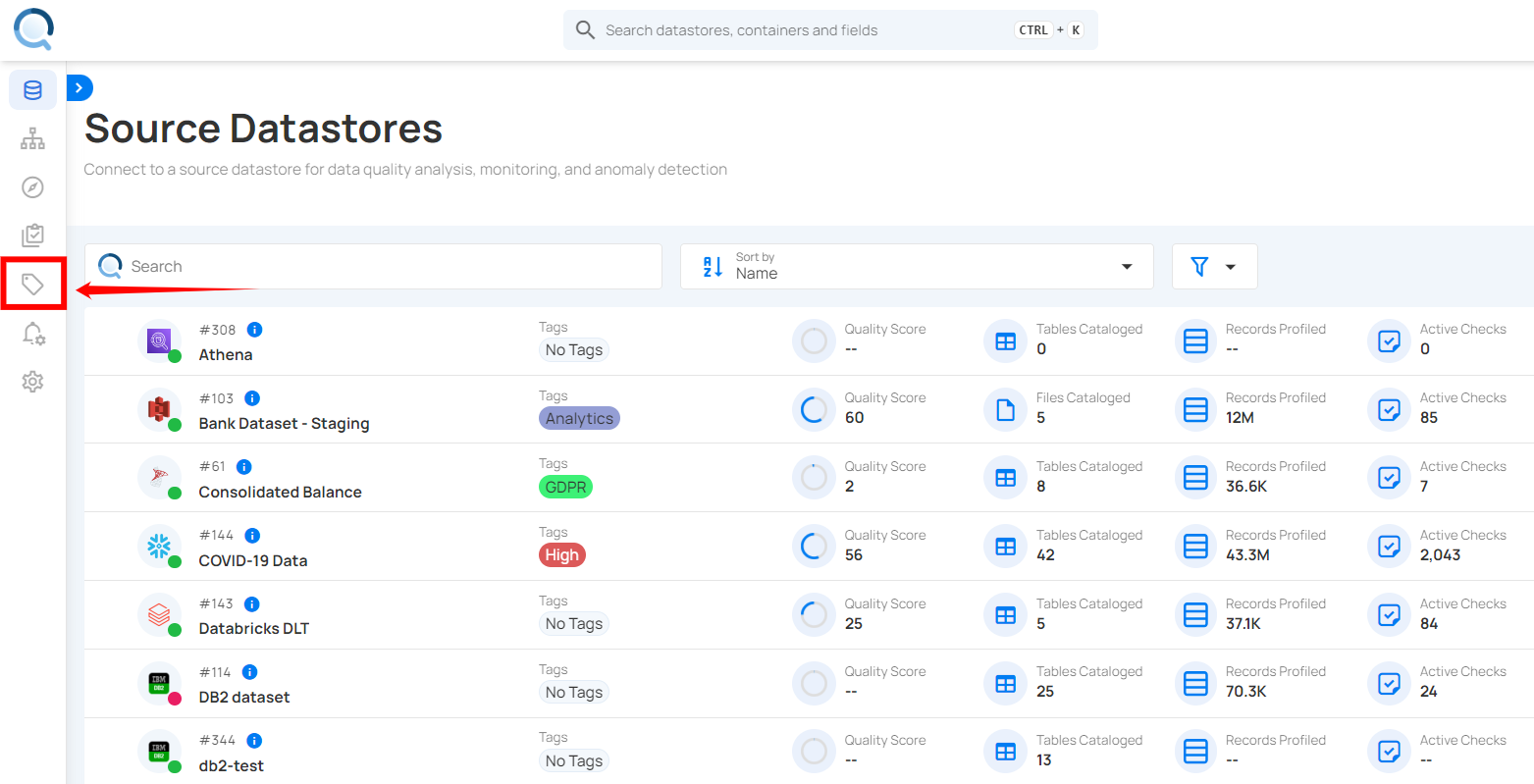
Step 1: Log in to your Qualytics account and click on the Tags on the left side panel of the interface.
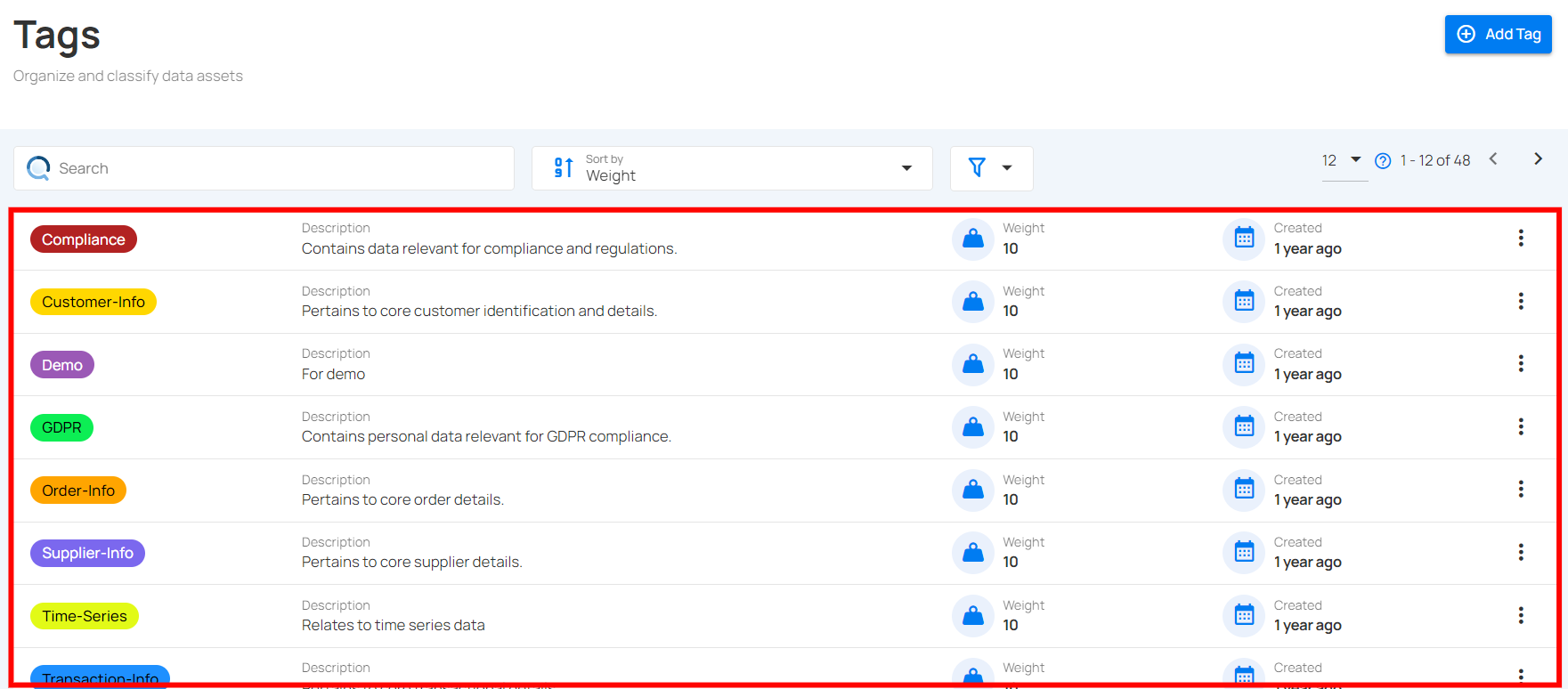
You will be navigated to the Tags section, where you can view all the tags available in the system.
Add Tag
Note
For more steps please refer to the add tag documentation.
Applying a Tag
Note
For more steps please refer to the applying a tag documentation.
External Tag
Note
For more information refer to the external tag
Filter and Sort
Note
For more steps please refer to the filter and sort documentation.
Edit Tags
Note
For more steps please refer to the edit tag documentation.
Delete Tags
Note
For more steps please refer to the delete tag documentation.