Deployment Options
- Managed deployment
- Self-hosted
Introduction
This guide summarizes the Qualytics deployment models and the main considerations for choosing between them.
Overview
The following two deployment models are supported for the Qualytics platform:
- Managed deployment: A single-tenant virtual private cloud (VPC) provisioned and operated by Qualytics.
- Self-hosted deployment: A single-tenant installation on a customer-managed, CNCF-conformant Kubernetes cluster, including on-premises environments.
Across both models, the following is true:
- Raw customer data is not stored at rest, but derivative data and selected values may be stored in the deployment.
- Read access is required to connect a datastore to Qualytics.
- Write access to a customer-selected datastore is required when using enrichment data.
Databricks on AWS Processing
For self-hosted organizations using Databricks on AWS, Qualytics provides a specialized processing option that runs in the customer's Databricks environment as a continuous job.
For setup instructions, see the Databricks on AWS Processing Deployment guide.
Managed Deployment
Overview
In this model, the Qualytics platform is deployed to a single-tenant virtual private cloud provisioned by Qualytics and with the provider and in the region of Customer's choosing. This VPC is not shared (single-tenant) and contains a single Customer Qualytics deployment.
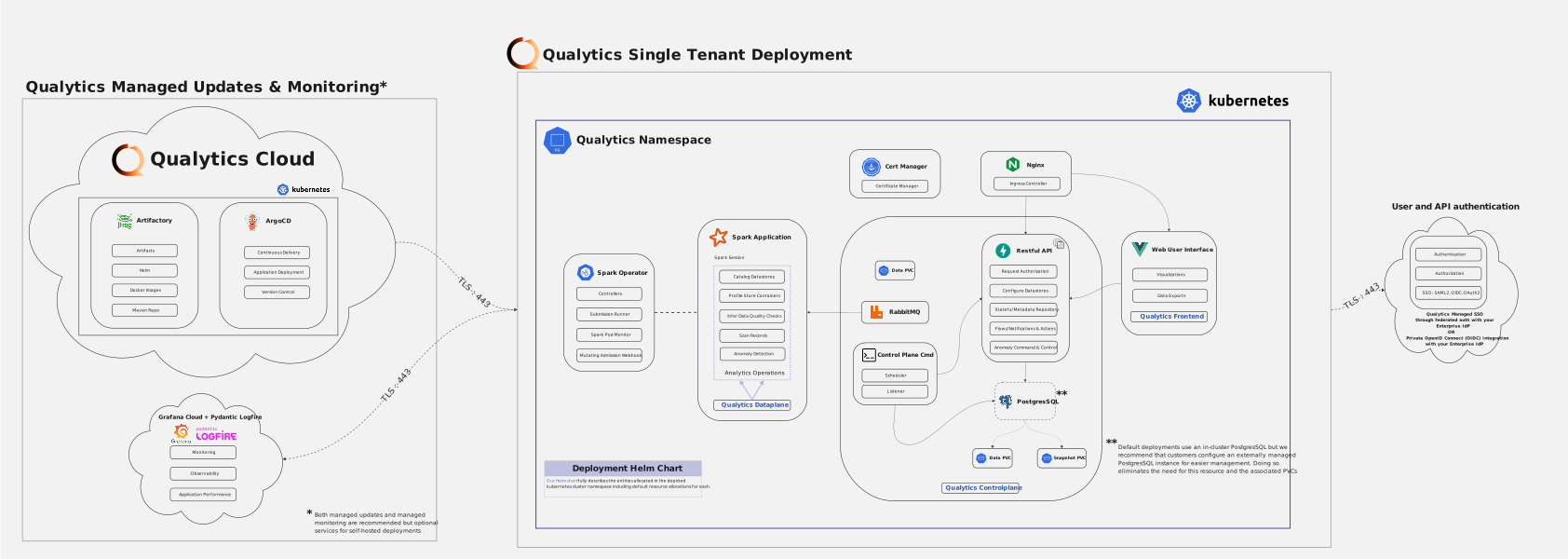
Supported Cloud Providers
Depending on Customer's cloud infrastructure, this option uses one of the following:
- EKS (Elastic Kubernetes Service)
- AKS (Azure Kubernetes Service)
- GKE (Google Kubernetes Engine)
- Oracle OKE (Oracle Container Engine for Kubernetes)
Network Requirements
This model requires that the provisioned VPC have the ability to access Customer's datastore(s). In the case of publicly routable datastores such as Snowflake or S3, no extra configuration is required. In the case of private datastore(s) with no public IP address or route, the hosted VPC will require private routing using: PrivateLink, Transit Gateway peering, point to point VPN, or similar support to enable network access to that private datastore.
Considerations
This is Qualytics' preferred model of deployment. In this model, Qualytics is fully responsible for the provisioning and operation of the Qualytics platform. Customer is only responsible for granting the Qualytics platform necessary access.
Self-Hosted Deployment
Overview
In this model, the Qualytics platform is deployed as a single-tenant instance on a CNCF-conformant Kubernetes cluster managed by the customer. This includes cloud and on-premises environments.
flowchart LR
    User["Qualytics users"]
    IdP["Customer IdP or Qualytics-managed authentication"]
    Sources["Customer data sources"]

    subgraph Cluster["Customer-managed Kubernetes cluster"]
        Entry["Customer ingress or optional chart ingress"]
        App["Qualytics application services"]
        Data["PostgreSQL and messaging services"]
        Driver["Processing driver"]
        Workers["Processing workers"]
    end

    User --> Entry
    Entry --> App
    IdP <--> App
    App --> Data
    App --> Driver
    Driver --> Workers
    Workers --> Sources
System Requirements
This option supports Kubernetes environments that meet these requirements:
- A currently supported Kubernetes version on a CNCF-conformant distribution; Kubernetes 1.30 or later is recommended.
- Separate capacity for application services, the processing driver, and dynamically scaled processing workers.
- Fast local storage for processing workers, sized for the selected deployment tier.
- A customer-resolvable fully qualified domain name for HTTPS access to the Qualytics UI.
- A Qualytics-provided image registry token and unique deployment identifier.
Resource needs depend on data volume and concurrency. Select a tier with your Qualytics account manager and review the current Cluster Sizing Guide before provisioning the cluster.
Network Requirements
The Kubernetes nodes running Qualytics processing workloads must be able to access the customer's datastores. The customer is responsible for the required routes, firewall rules, DNS, and certificates.
Considerations
This model supports organizations that cannot permit read access to their datastores from a third-party hosted product. The customer manages the infrastructure, installs approved chart versions, performs upgrades, and provides the required datastore access.
For deployments to supported commercial Kubernetes services such as EKS, AKS, GKE, and OKE, Qualytics can help provision the deployment and transfer ownership of the infrastructure to the customer. Otherwise, the customer provisions the cluster and installs the platform using the Qualytics Helm chart.
Terraform Templates Available: To simplify infrastructure provisioning, we provide ready-to-use Terraform templates for AWS, GCP, and Azure. These templates create Kubernetes clusters with the correct node pools, labels, storage classes, and networking configuration required for Qualytics deployments.