Between Times
Use the betweenTimes rule when you need to validate that date or timestamp values fall within an expected time window. This check is ideal for catching early, late, or invalid records caused by ingestion delays, timezone issues, or system errors.
What is Between Times?
Think of Between Times as a time window guardrail for your data ⏱️.
Just like a store that only accepts deliveries between 9 AM and 6 PM, this check makes sure your data shows up when it’s supposed to—not before, not after.
If a record arrives too early, too late, or completely outside the allowed window, Between Times flags it immediately.
In simple terms: Between Times makes sure your data arrives on time—and only on time.
Add Between Times Check
Use the Between Times check to validate timestamps, enforce business hours, and detect out-of-range records before they impact reporting or downstream systems.
What Does Between Times Do?
Between Times helps you answer questions like:
- “Did these records arrive during valid business hours?”
- “Are any timestamps outside the expected date range?”
- “Did old or future-dated records sneak into my dataset?”
In simple terms: It ensures every date or timestamp stays within an allowed start and end time.
How Does Between Times Work?
Step 1: Choose the Time Field
Select the date or timestamp field you want to validate (for example, created_at or event_time).
Step 2: Define the Allowed Time Window
Set:
- Start Time
- End Time
This could be a date range, business hours, or a strict ingestion window.
Step 3: The Validation Happens
Between Times checks every record:
-
Inside the window → ✅ Pass
-
Outside the window → ❌ Flagged as anomalous
Step 4: Review the Results
If violations exist, you’ll see exactly:
- Which records failed
- By how much they were early or late
- Which field caused the anomaly
Why Should You Use Between Times?
1. Catch Timing Issues Early
Late or early data can silently corrupt reports. This check surfaces issues immediately.
2. Prevent Invalid Historical or Future Data
Old test records or future-dated entries won’t sneak into production analytics.
3. Improve Trust in Time-Based Reports
Dashboards, SLAs, and audits depend on correct timestamps. Between Times keeps them reliable.
4. Reduce Downstream Failures
Many pipelines break when timestamps are out of range. This check stops bad data upstream.
Real-Life Example: City Infrastructure Dataset
The Situation
A city data team manages a building permits dataset. Each permit record includes a CREATED_DATE field that should fall between:
- January 1, 1995
- June 2, 2019
This dataset feeds:
- Urban planning reports
- Historical trend analysis
- Compliance dashboards
The Problem They Faced
Over time, the team noticed strange trends in reports:
- Some permits appeared decades too early
- Others showed dates far in the future
- KPIs based on yearly counts were off
They suspected bad timestamps but had no automated way to catch them.
The Solution: Between Times
They configured a Between Times check on the CREATED_DATE field with the allowed date range.
Rule Setup:
- Field:
CREATED_DATE - Start Time:
1995-01-01 - End Time:
2019-06-02
What Between Times Discovered
VIOLATION DETECTED
- Field:
CREATED_DATE - Rule Applied: Between Times
- 21.98% of records were outside the allowed time window
Example of Flagged Records:
| CREATED_DATE | CT2010 | XCoord | CB2010 |
|---|---|---|---|
| 1990-03-05T16:36:27.448Z | 112 | 959857 | 2034 |
| 1993-03-28T09:24:21.483Z | 112 | 959604 | 1020 |
| 1993-08-19T01:27:27.406Z | 70 | 959403 | 2009 |
| 2020-04-08T13:08:12.275Z | 239 | 942672 | 1006 |
| 1992-06-28T02:11:50.123Z | 207 | 947120 | 3000 |
| 2020-11-04T16:30:36.819Z | 177 | null | null |
| 2020-06-04T14:36:40.406Z | 177 | 958051 | 2002 |
| 1991-03-20T21:22:40.939Z | 187 | 948974 | 1015 |
| 1992-09-20T18:47:49.845Z | 169 | 951372 | 1012 |
| 2019-10-16T12:39:31.870Z | 169 | 953637 | 1002 |
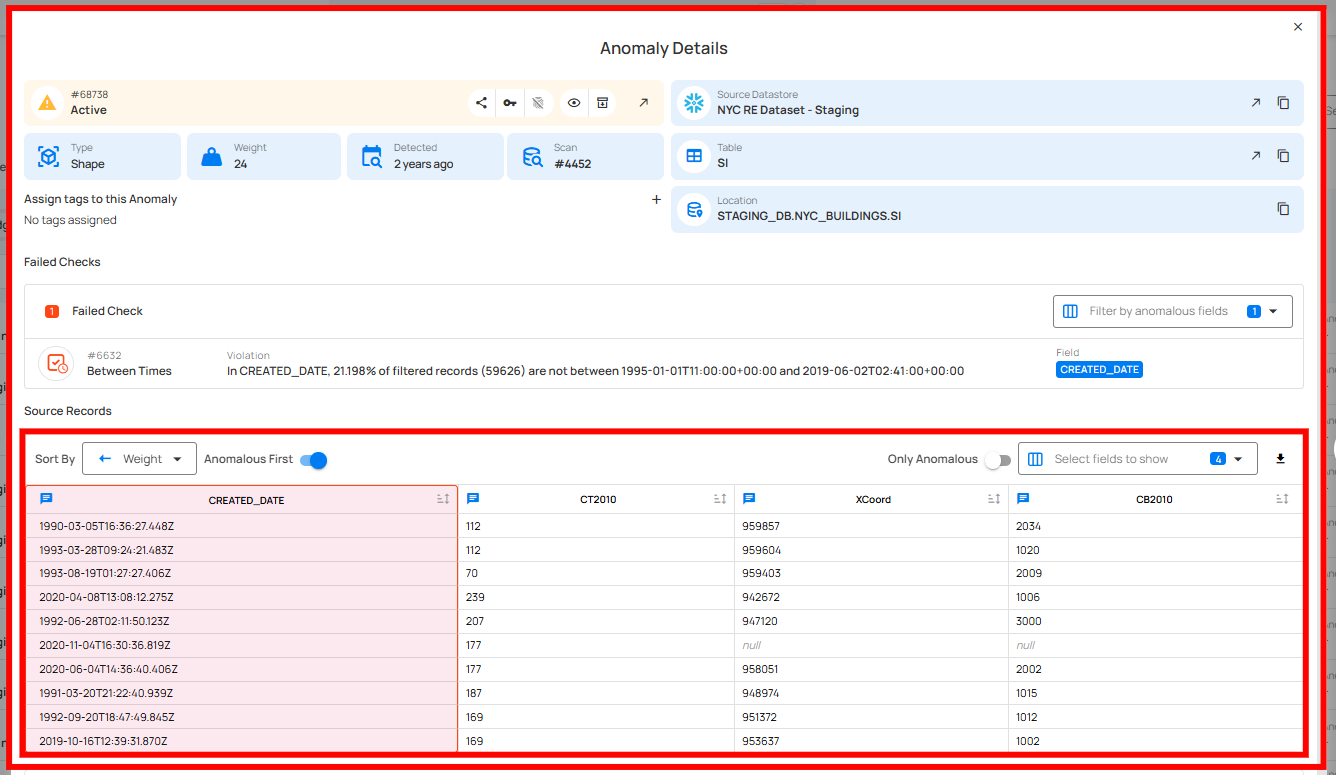
🔍 Summary
- These records fall outside the valid historical window
- They likely came from:
- Legacy system imports
- Incorrect timezone conversions
- Manual data entry errors
- Without this check, they were silently skewing reports
The Outcome
Immediate Benefits: - Invalid records were identified in minutes - Analysts excluded bad data from reports - Data quality issues were traced to the source system
Long-Term Benefits: - Automated monitoring for timestamp validity - Accurate historical reporting - Increased trust in time-based analytics - Fewer surprises during audits
Key Takeaways
Between Times acts like a time gate for your data.
- It ensures records arrive only within expected time windows
- It catches early, late, and impossible timestamps
- It runs automatically once configured
- It protects reports, dashboards, and downstream systems
When Should You Use Between Times?
Use Between Times whenever you need to validate when data occurs:
- Event ingestion timestamps
- Record creation dates
- Business hours enforcement
- Historical data boundaries
- SLA and compliance monitoring
Field Scope
Single: The rule evaluates a single specified field.
Accepted Types
| Type | |
|---|---|
Date |
|
Timestamp |
General Properties
| Name | Supported |
|---|---|
Filter Allows the targeting of specific data based on conditions |
|
Coverage Customization Allows adjusting the percentage of records that must meet the rule's conditions |
The filter allows you to define a subset of data upon which the rule will operate.
It requires a valid Spark SQL expression that determines the criteria rows in the DataFrame should meet. This means the expression specifies which rows the DataFrame should include based on those criteria. Since it's applied directly to the Spark DataFrame, traditional SQL constructs like WHERE clauses are not supported.
Examples
Direct Conditions
Simply specify the condition you want to be met.
Combining Conditions
Combine multiple conditions using logical operators like AND and OR.
Correct usage" collapsible="true
Incorrect usage" collapsible="true
Utilizing Functions
Leverage Spark SQL functions to refine and enhance your conditions.
Correct usage" collapsible="true
Incorrect usage" collapsible="true
Using scan-time variables
To refer to the current dataframe being analyzed, use the reserved dynamic variable {{ _qualytics_self }}.
Correct usage" collapsible="true
Incorrect usage" collapsible="true
While subqueries can be useful, their application within filters in our context has limitations. For example, directly referencing other containers or the broader target container in such subqueries is not supported. Attempting to do so will result in an error.
Important Note on {{ _qualytics_self }}
The {{ _qualytics_self }} keyword refers to the dataframe that's currently under examination. In the context of a full scan, this variable represents the entire target container. However, during incremental scans, it only reflects a subset of the target container, capturing just the incremental data. It's crucial to recognize that in such scenarios, using {{ _qualytics_self }} may not encompass all entries from the target container.
Specific Properties
Specify the range of dates or times that values in the selected field should fall between.
| Name | Description |
|---|---|
Min |
The timestamp used as the lower boundary. Values in the selected field should be after this timestamp. |
Max |
The timestamp used as the upper boundary. Values in the selected field should be before this timestamp. |
Anomaly Types
| Type | Supported |
|---|---|
Record Flag inconsistencies at the row level |
|
Shape Flag inconsistencies in the overall patterns and distributions of a field |
Example
Objective: Ensure that all O_ORDERDATE entries in the ORDERS table are between 10:30 AM on January 1st, 1991 and 3:00 PM on December 31st, 1991.
Sample Data
| O_ORDERKEY | O_ORDERDATE |
|---|---|
| 1 | 1990-12-31 10:30:00 |
| 2 | 1991-06-02 09:15:00 |
| 3 | 1992-01-01 01:25:00 |
{
    "description": "Ensure that all O_ORDERDATE entries in the ORDERS table are between 10:30 AM on January 1st, 1991 and 3:00 PM on December 31st, 1991",
    "coverage": 1,
    "properties": {
        "min_time":"1991-01-01T10:30:00Z",
        "max_time":"1991-12-31T15:00:00Z"
    },
    "tags": [],
    "fields": ["O_ORDERDATE"],
    "additional_metadata": {"key 1": "value 1", "key 2": "value 2"},
    "rule": "betweenTimes",
    "container_id": {container_id},
    "template_id": {template_id},
    "filter": "_PARITY = 'odd'"
}
Anomaly Explanation
In the sample data above, the entries with O_ORDERKEY 1 and 3 do not satisfy the rule because their O_ORDERDATE values are not between 1991-01-01 10:30:00 and 1991-12-31 15:00:00.
graph TD
A[Start] --> B[Retrieve O_ORDERDATE]
B --> C{Is '1991-01-01 10:30:00' <= O_ORDERDATE <= '1991-12-31 15:00:00'?}
C -->|Yes| D[Move to Next Record/End]
C -->|No| E[Mark as Anomalous]
E --> DPotential Violation Messages
Record Anomaly
The value for O_ORDERDATE of 1990-12-31 10:30:00 is not between 1991-01-01 10:30:00 and 1991-12-31 15:00:00.
Shape Anomaly
In O_ORDERDATE, 66.667% of 3 filtered records (2) are not between 1991-01-01 10:30:00 and 1991-12-31 15:00:00.